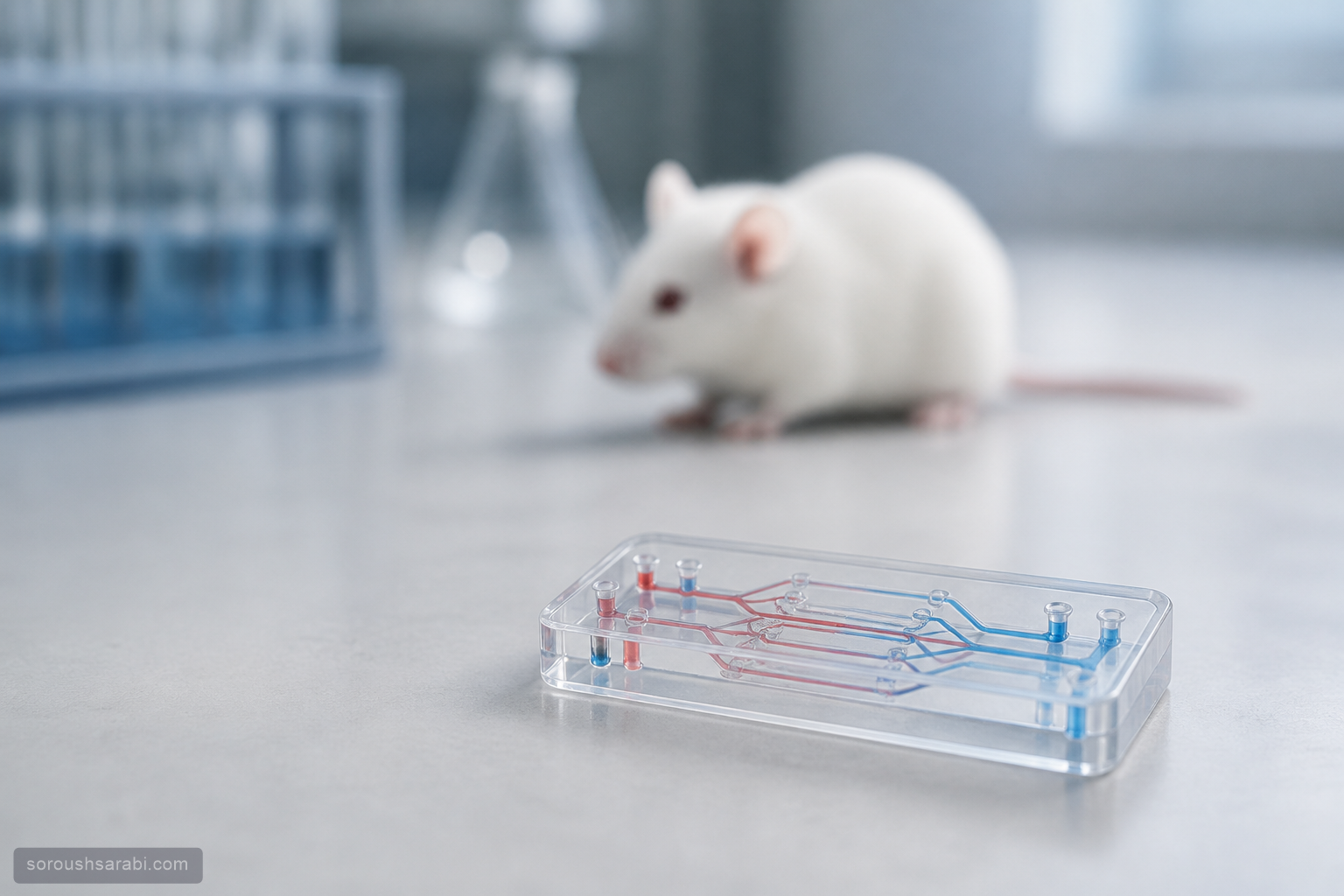
In 2009 Donald Ingber and his colleagues at Harvard's Wyss Institute submitted a paper to Science describing an artificial lung. It was smaller than a USB stick, made from a slab of clear polymer with narrow channels inside, and those channels were lined with the same cells that line a human lung's air sacs and blood vessels. When air was pumped through chambers beside the channels, the whole device expanded and contracted rhythmically. Put plainly, it breathed.
Science's editors rejected the paper and suggested the team repeat the experiments in mice. That was not an unreasonable request: the method was new, and comparing it against mice would help establish whether it could be trusted. Ingber's group ran the mouse experiments, the paper appeared a year later, and it has since been cited nearly 5,400 times.
Now set this year's story beside it. According to an executive at TissUse, a German company that builds these chips, a pharmaceutical company approached them a few months ago after the FDA had refused to let its drug begin human trials. The reason was that the company had presented only animal data, and the agency wanted chip data or something comparable. In seventeen years the standard has turned completely around.
But there is a question underneath this that rarely gets asked out loud, and it is what this piece is about. When we measure the new method against the mouse, what did we ever measure the mouse against?
a lung that breathed
Start with what these devices actually are, because the name misleads. An organ-on-a-chip is a small piece of clear plastic with channels inside, in which human cells from one particular organ are grown so that they feel the same movement and flow they would feel in the body.
In Ingber's lung, air-sac cells grow on one side of a porous membrane and blood-vessel cells on the other, while vacuum channels stretch and relax the tissue to mimic breathing. When bacteria were added to the air channel and white blood cells to the blood channel, the white cells crossed the membrane and engulfed the bacteria, the same inflammatory response that happens in a real lung.
Since then there have been livers, hearts, kidneys, brains and even placentas on chips, and as many as ten organs have been linked together to simulate how several of them behave side by side. None of these is a whole body, but their cells are human rather than mouse or monkey.
why change at all
The short answer is a number. Roughly 92% of drugs that enter human trials in the US never reach the market. Some fail for business reasons, but many fail because they turn out ineffective or dangerous in people in ways that animal testing did not predict.
Fairness requires saying that this figure alone does not put all the blame on the mouse. Poor study design and the sheer complexity of disease play a part, and the IEEE Spectrum report makes the same caveat itself. But there is little doubt that animals are poor stand-ins for humans in many conditions. And the error runs both ways: just as a mouse can make a drug look safe that later harms people, it can make a drug look dangerous that would have worked. Some researchers argue that if aspirin or acetaminophen had been discovered under today's testing rules, they might have been abandoned.
the door opened, but only the door
The next question is why, if this is so clear, nothing changed. Until a few years ago the law did not allow it. US regulations treated animal testing as mandatory for every new drug, and until regulators accept something else, no company has a reason to invest in it.
That barrier came down in stages. Late in 2022 a law explicitly allowed non-animal methods in the studies required before human trials. In 2025 the FDA pledged to make animal studies the exception rather than the norm, and the National Institutes of Health required that research using animals also incorporate non-animal methods. Europe and the UK have announced their own plans to phase animal testing out.
And on 21 September this year the FDA issued a rule replacing "animal tests" in its regulations with "nonclinical tests". It is worth reading exactly what the rule does and does not do. It does not ban animal studies, it does not change the evidence required, and it imposes no new costs on companies. It simply removes language that could be read as saying animal testing is the only acceptable route, and alongside it the agency launched a database of 25 real examples of the new methods in use. The door is open, in other words, but nobody has yet been made to walk through it.
an exam retaken for every use
Now we reach the hard part. Legal permission is not enough, because you have to prove your method can be trusted, and that proof is the most expensive part of the whole business.
Ingber puts it bluntly. Chips coming out of academic labs are fine, but they will not convince the FDA, because they have to give the same results anywhere in the world. That means they have to be commercial products, manufactured at scale to tight performance criteria. Even tiny variations in the gel the cells grow on can produce completely different growth patterns.
Follow the numbers from one of the few studies that has actually done this proving, because they show why it moves so slowly. Emulate tested its liver chip on 27 drugs, blinded, so whoever read the results did not know which drugs were toxic. It used 870 chips. Among drugs that had passed animal testing yet later harmed human livers, the chip caught roughly seven in every eight, and it did not wrongly flag a single safe drug as toxic.
The result is excellent. Now look at the cost. According to Spectrum, the study took 16 full-time people 16 weeks, which is 256 working weeks, or close to five years of one person's labour. Worse than the cost is the scope. That proof holds only for small-molecule drugs; to use the same chip on large-molecule drugs, the company would need to run a whole new study. And the same is true for every chip on the market and every use anyone has in mind for it.
One long-time advocate for replacing animal tests summed it up: it takes too long, it costs too much, and small companies cannot afford it.
the report card nobody read
Go back to the opening question. The chip has to pass an expensive exam separately for every kind of drug and every use, and the pass mark is often agreement with the mouse. But how did the mouse become the standard?
My reading is that the mouse became the standard because it was there first, not because it passed this exam. When Science's reviewer asked for a comparison against mice in 2009, they were measuring a new method against an established one, which is exactly what any careful assessment does. The trouble starts when the established method was never measured against humans and still stays everyone else's yardstick.
What is striking is that wherever someone has bothered to set the mouse's report card beside the chip's, the mouse's grades have not been brilliant. In one study reported by Spectrum, a computer simulation of human heart cells identified drugs that cause a dangerous kind of heart-rhythm disorder with 89% accuracy, while animal tests on the same drugs were 75% accurate. And the liver chip caught precisely the drugs that had sailed through animal testing.
So the mouse's report card exists. Until recently nobody went looking for it, because the mouse was never in a position where it had to prove anything. The burden of proof sat entirely on the newcomer.
a problem every engineer knows
Put a legacy software system and its replacement in place of the mouse and the chip, and everything looks familiar. I have watched this scene play out many times in legacy replacements. The old system has run for years, and its outputs, errors included, have quietly become the definition of correct behaviour. However much better the new system is, it first has to prove it produces the same outputs, and wherever it differs, the first assumption is that the new system is wrong.
The usual remedy is the same in both worlds. You run the two side by side for a while and compare their outputs until trust is built. Thomas Hartung of Johns Hopkins proposes exactly this: that new animal experiments be run in parallel with the new methods, so that head-to-head comparisons accumulate. And the line attributed to him sums up this whole piece: the transition is more about change management than about the technology.
There is one important difference, though. In software you at least have the old system's outputs to compare against. Here much of the data from past animal and human studies is held by companies and never published, so even the comparison is hard. The FDA has called for an open repository of drug-toxicity data, and until that data comes out, every new chip has to build its report card from scratch.
what is missing is not a device
If you take one thing from all this, it is that what we lack is not a better device. A lung that breathes was built seventeen years ago, and the liver chip has caught toxic drugs that the mouse let through.
What is missing is the infrastructure of trust, and none of it looks like an invention: common standards so that different groups can compare their results; shared data that no company has to assemble from nothing; and funding for comparison studies that no small lab can carry alone.
And beneath all of that sits a simpler task that has still not been done in full: reading the mouse's report card with the same rigour we bring to the chip's.