Computational Biology
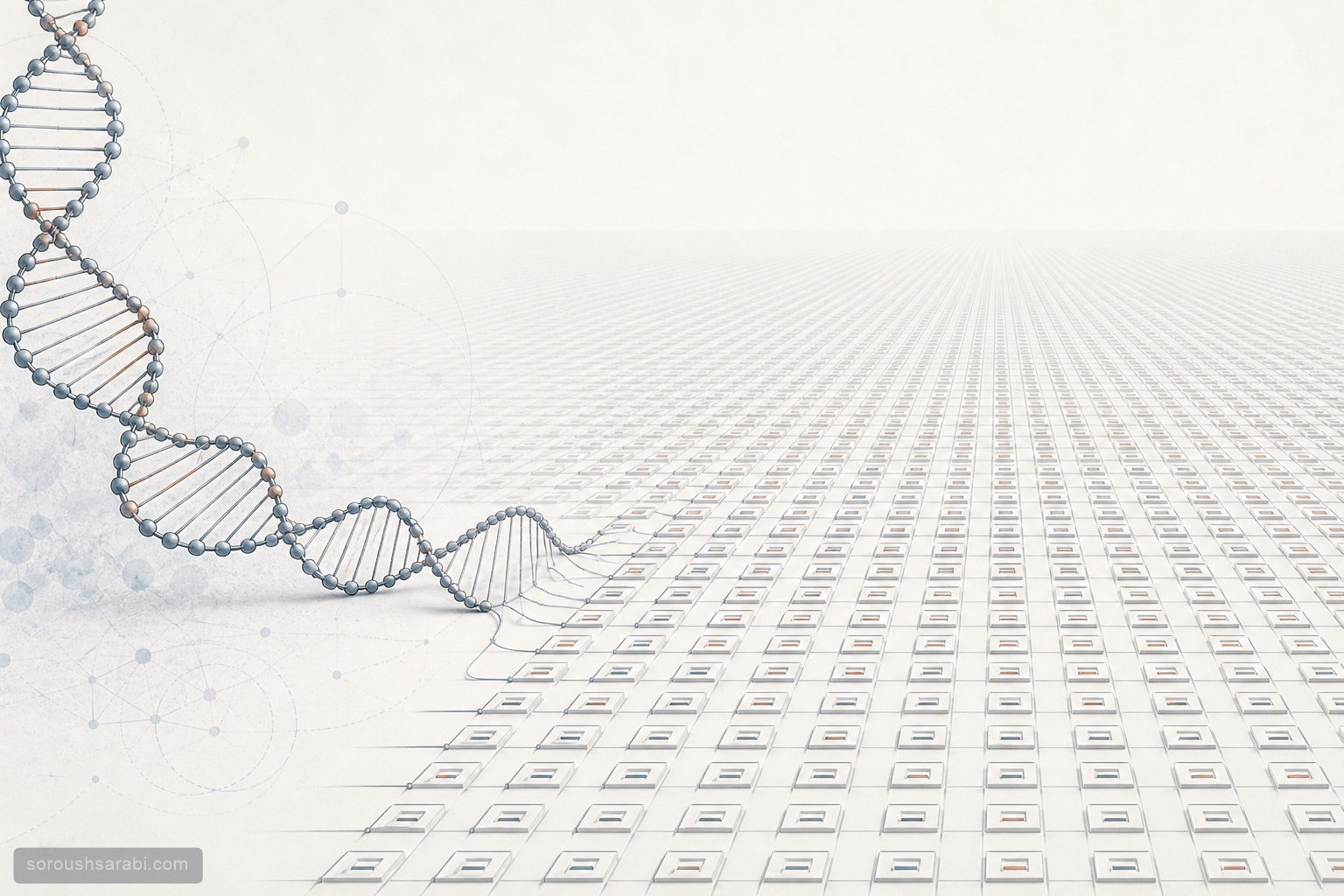
a petabyte of answers
Until this week, finding out what one changed letter of DNA does to the genes around it meant picking your variants, writing code, and running a slow, heavy model for hours. DeepMind ran it once for all nine billion possible single-letter changes and published the results, a petabyte of ready answers. But every variant ends up as a single score, and that score measures something you probably would not guess.
it wrote 302 genomes, sixteen came alive
A language model trained on more than two million viral genomes wrote 302 new ones. Seventeen could not be synthesised at all, and of the remaining 285 only 16 came alive and killed bacteria. The headlines said AI had designed viruses; then an independent team went and measured how novel those genomes actually were, and the answer was that the model is efficient precisely because it stays close to what it has already seen.

simulating cancer cells, one molecule at a time
A new GPU-accelerated simulator treats every molecule inside a cell as an autonomous agent — and reproduces real clinical drug-response curves for BRAF-mutant cancer. Here is what that means, and why it is a more honest way to model biology than the equations we have been using for decades.

The shift from continuous equations to parallel agents: scaling cancer pathway simulations on GPUs
Deterministic differential equations fail to capture the spatial complexity of cellular pathways. Transitioning to GPU-accelerated agent-based modeling offers a scalable, physically grounded alternative for in silico oncology.