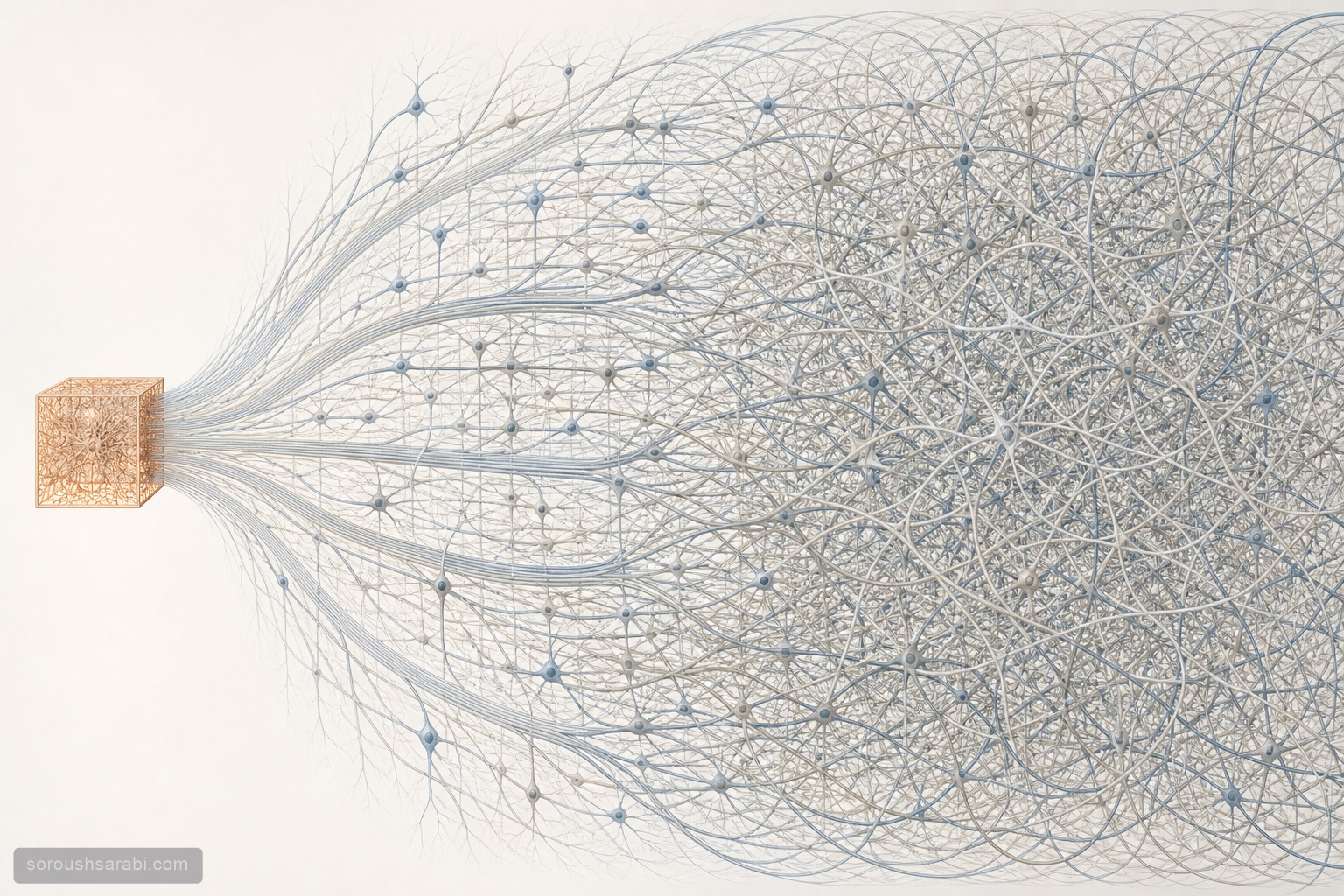
In 2024 a Harvard and Google collaboration published H01: one cubic millimetre of human temporal cortex, mapped by electron microscopy at nanometre resolution. The volume is smaller than a grain of rice and holds roughly 57,000 cells and something close to 150 million synapses. Imaging that single fragment took a petabyte. It is the finest-grained map of human neural tissue in existence.
Now someone has taken that map and wired it up as a language model's memory, and reports that the model recalls a six-letter word with perfect accuracy. The number is real, the code and weights are public, and anyone can reproduce it. But the result is not what makes this worth reading. What makes it worth reading is that the author also published the experiment showing the human cortex was not doing the work.
what is attached to what
Start with what was actually built, because most of the misreading begins here. The language model was not changed. At the centre of this sits an ordinary, untouched Qwen2.5-0.5B-Instruct whose weights never move and into which nothing is merged.
What was added is a separate file, and the authors are explicit that the artifact is that file rather than a model. Inside it are the neuron graph, an excitatory or inhibitory sign for every synapse, and a handful of small trained weights. The graph works as an associative memory, meaning a memory addressed by content rather than by slot number. At recall time, memory tokens are injected midway through the model's layers and the layer outputs are read back.
So the division of labour is clean. Language and reasoning come from the model itself, and the graph's 13,473 slots are storage and nothing more. The author says as much outright: this thing remembers, it does not reason.
the claim is not the brain, it is that the memory does not grow
The right question is what the graph buys you if the model is untouched. The answer starts with how a transformer remembers at all.
To hold onto something, a transformer keeps its tokens in a cache that grows with every new token, the KV cache. The trouble is that a model only ever has a limited stretch of text in front of it, and once a document runs longer than that stretch, the beginning of it is simply gone with no route back.
This graph does not grow, and the reason is a multiplication worth doing yourself. The memory holds one slot per neuron, and 328 numbers sit in each slot. For the fly brain, 8,552 slots times 328 numbers times four bytes is 11.2 MB; for the human brain, 13,473 slots on the same arithmetic gives 17.7 MB. That figure is fixed and has nothing to do with document length. A thousand tokens or a million, the memory is the same 17.7 MB.
the test was simple, its controls were not
The test takes one line to describe. A six-letter string is stated once and buried under filler. The model never sees more than 128 tokens at once, and the question is asked at a point where that string is no longer among those 128 tokens, so the fact and the question cannot possibly be in front of it together. The filler words are generated fresh for every sample, so there is nothing to memorise.
Four numbers are reported, and the last three are worth more than the first.
| measurement | result |
|---|---|
| no graph, a fact the model can no longer see | 0% |
| with the human graph | 100% |
| control: a word the document never contained | 0% |
| control: a graph that read a different document | 0% |
Why do those three matter more? Because without them you cannot tell what you measured. The first row says the task is impossible without memory, so the 100% is not coming from the model's own ability. The last two rows rule out a system that is leaking from somewhere else: if a graph that read a different document also answers correctly, the answer was never coming from this document. The model card puts it better than I can, in that a graph which scores on the first row and also on the last two is leaking rather than remembering.
from a cubic millimetre to a graph: three traps
Here is the most interesting engineering in the whole thing, and it will be familiar to anyone who has worked with biological data. Take H01's cell table, build the graph naively, and what you get is confidently wrong.
The first trap: cells that are not neurons. Those 57,000 cells are not all neurons; roughly 32,000 are glia, meaning astrocytes, oligodendrocytes and microglia, whose job is to support neurons. Extract synapses without filtering them out and the single most populous edge class in the whole dataset becomes astrocyte to pyramidal neuron at 52,177 connections, ahead of pyramidal to pyramidal at 38,713. And astrocytes do not form chemical synapses onto pyramidal cells. What has actually happened is that astrocyte processes wrap around real synapses, and the automated detector reports the wrapper instead of the synapse. The author's own line settles it: a graph whose commonest connection is biologically impossible is not a connectome, it is a map of a detection artifact.
The second trap: sign. Whether a synapse is excitatory or inhibitory is no small matter, because that is what decides whether a network settles or runs away. H01's detector proposes its own sign for each synapse, and it is tempting to take it. Instead they checked those signs against Dale's law, the principle that a neuron releases the same neurotransmitter at all its terminals, so a pyramidal cell is excitatory everywhere and an interneuron inhibitory everywhere. Agreement was 57.5%, barely better than a coin flip. They took the sign from cell type and reported the disagreement rather than quietly picking whichever flattered them. The result was 9,940 excitatory neurons against 3,533 inhibitory, so 26.2% inhibitory.
The third trap: the block boundary. Of the roughly 166 million detected synapses, only about 0.3% join two cells whose somas both sit inside the volume. The rest land on branches cut off at the edge of the block, for a simple reason: the arbour of a cortical neuron reaches far beyond a cubic millimetre. So the extractor streams all 166 file shards one at a time, keeps that 0.3%, and throws each shard away as it goes, a trick that brings peak disk down to 200 MB instead of 33 GB.
What survives all three filters is 13,473 neurons and 75,452 connections carrying 114,227 synapses, with the cortical layer recorded for every cell.
human against fly
An earlier version of this work used a fruit fly's brain, and comparing the two is instructive.
| graph | cells | synapses | state | 100% at step |
|---|---|---|---|---|
| fly, associative core | 8,552 | 300,880 | 11.2 MB | 26 |
| H01 human cortex | 13,473 | 114,227 | 17.7 MB | 44 |
The fly graph is not the whole fly brain: that full volume holds 188,778 neurons and over 26 million synapses, and only the parts that serve as associative memory in the fly itself were taken, the mushroom body and the central complex, pruned down to 8,552 neurons.
Put the numbers side by side. The human graph has 1.6 times the cells but fewer synapses: 1.51 per connected pair, against the fly's dense wiring. The reason is the third trap. The fly graph is a complete brain and H01 is a fragment of an enormous one, so most of any cortical neuron's real connections have left the volume. The consequence is that the human graph learns a little more slowly, reaching 100% at step 44 rather than step 26, and ends up in the same place.
the experiment the author ran on his own work
So far this all reads like good news about the human brain. Here is the part this piece exists for.
The author took the fly graph and scrambled it. Not any old scramble: the same neurons in place, the same synapse count, the same multiset of weights, and, most importantly, each neuron's in-degree and out-degree left exactly intact. Only which edge lands on which neuron was randomised, and that was done for 99.94% of the edges.
The scrambled graph reached 100% at the same training step.
On this particular task, then, real brain wiring held no measurable advantage over a random graph matched only on degree. What works is the shape of the graph and its sparsity at a workable scale, each neuron connecting to only a handful of others, and the retrieval is done by the associative memory sitting on top. His own sentence says it: the biology is supplying a well-conditioned substrate, not a secret.
There is one more thing here that gets less attention. An earlier version of that same model card claimed a 9.2-point advantage for the connectome, and he has written that the figure was measured on a different architecture and does not hold here. He withdrew his own claim and replaced it with an experiment that contradicts what he first said.
This is what a control experiment is for. The result stayed and only the story died, and the true story is the more useful one, because you now know you need no connectome at all to build this.
where 100% becomes 46%
There is a detail in the documentation that looks minor and in fact defines the specification of this memory.
Every token is filed under the few words that came immediately before it, so a query has to reproduce those same words to arrive at the right address. The document says "the secret word is" and the query has to end with that same phrase. Ask only what the secret word was and a graph that scored 100% scores 46%.
That is not a bug report, it is a definition of what was built. This memory is not a key-value table that answers however you call it; it is a memory whose address is made out of the context preceding each token. The memory sits there intact and only the question arrived at the wrong number.
The next limitation is reported just as plainly. Recalling one fact from one document is solved, but when several facts sit in one document and the right one has to be picked, accuracy drops to 72–80%. The author calls that an open problem.
what this actually shows
If you take one sentence away from all this, that sentence is not about the human brain.
What has been demonstrated is that a language model's long-term memory can be lifted out of the model and put in a separate store that does not grow with document length, and that this works on a half-billion-parameter model with 17.7 MB of memory. For anyone who has wrestled with how little text a model can hold at once, that matters a great deal, and it has nothing to do with brains.
The human brain's contribution here was something a random graph could have supplied just as well, provided its size, sparsity and degree distribution were right. And the reason we can say that with confidence rather than with hedging is one thing only: someone went to the trouble of running that control and published what it said, even when what it said cut against the attractive headline on his own work.